

International Institute for Genocide
and Human Rights Studies
A Division of the Zoryan Institute
The 2027 Program
The 2027 syllabus is currently being finalized.
For reference, the 2026 syllabus can be viewed here.
Taking the Program for Credit
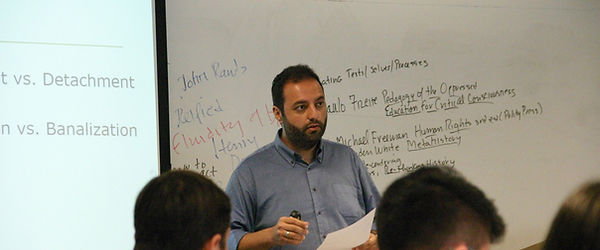
Many universities will give graduate-level credit for participating in the GHRUP. In this case, students must approach a professor at their university with the syllabus and faculty biographies for approval as an “independent study” or “directed reading” course.
Participants who would like university credit for the course must indicate this at the time of applying.
Credit is subject to approval by your university and must be authorized in advance. Be sure to discuss the options and the process with IIGHRS staff before starting the program.
Oral Presentation
Students will be expected to prepare a ten-minute oral presentation to present to the class at the end of the course. More details will be provided in the syllabus and by the Course Director at the start of the program.
Reading Materials
All required readings will be provided to students at no additional cost.
2027 Faculty

Alexander Alvarez
Program Director | Northern Arizona University
UNIT(S): "Theories of Genocide" & "Genocide Prevention"
Dr. Alex Alvarez is a Professor in the Department of Criminology and Criminal Justice at Northern Arizona University. From 2001 until 2003 he was the founding Director of the Martin-Springer Institute for Teaching the Holocaust, Tolerance, and Humanitarian Values. In 2017-2018, he served as the Ida E. King Distinguished Visiting Scholar in Holocaust and Genocide Studies at Stockton University. His main areas of study are in the areas of collective and interpersonal violence.
His books include Governments, Citizens, and Genocide, Murder American Style, Violence: The Enduring Problem, Genocidal Crimes, Native America and the Question of Genocide, and Unstable Ground: Climate Change, Conflict, and Genocide. His newest forthcoming book is Lethal Elites: The Institutions and Professionals that Made the Holocaust Possible. He has also served as an editor for the journal Violence and Victims, was a founding co-editor of Genocide Studies and Prevention, and is an editor for Genocide Studies International.
He is also the vice chair of the Academic Advisory Board for the Zoryan Institute, is the course manager for Zoryan’s two week Genocide and Human Rights Graduate Seminar at the University of Toronto, is a member of the Genocide Education Task Force for the state of Arizona which successfully worked to get genocide and Holocaust education mandated in the state, and is one of the organizers and directors of Genocide Awareness Week. He has been invited to speak and present his research across the U.S., Canada, Europe, and South America.

Joyce Apsel
Course Director | New York University
Joyce Apsel Ph.D., J.D., is Clinical Professor of Humanities in Liberal Studies, College of Arts & Sciences at New York University, and President of the Institute for Study of Genocide.
Based on her research interests in comparative genocide and human rights, she teaches seminars in the Politics, Rights and Development Concentration. Course subjects include Human Rights, Cultures of Peace and Terror, Global Violence, Societies at Risk, Politics of Mass Hate and Genocide, and Re-thinking, Human Rights, Humanitarianism and Global Citizenship. Together, in small classes, her students read about and debate the history and politics of just and unjust wars, the role of non-governmental organizations and the complex challenges of addressing targeted violence past and present---in the Ukraine to Chechnya to Darfur as well as structural violence in the US and elsewhere. Students have the opportunity to research their own interests; recent projects and senior theses include Child Soldiers, HIV/AIDs and the Globalization of Drugs, Photography and Atrocity, Female Slave Trafficking in Southeast Asia and Eastern Europe to aspects of the Indigenous Peoples and Slavery and the Global Migrant Crisis. Her goal is to explore diverse perspectives and critical analyses that facilitate each student finding his/her own voice and becoming informed, engaged, members of civil society and the global community. She is a recipient of the NYU Distinguished Teaching Award and of the student-nominated NYU Martin Luther King, Jr. Teaching Award (2022).
Joyce Apsel is the author of Introducing Peace Museums (2016), nominated for the 2017 Dayton Literary Peace Prize in non-fiction. She is also the co-author with Amy Sodaro of Museums and Sites of Persuasion: Politics, Memory, and Human Rights (2019) and co-editor with Ernesto Verdeja of Genocide Matters: Ongoing Issues and Emerging Perspectives (2013).

Jennie Burnet
Georgia State University | UNIT(S): "The Rwandan Genocide" & "Gender and Genocide"
Jennie E. Burnet is Professor of Anthropology and Director of the Institute for Women’s, Gender & Sexuality Studies at Georgia State University in Atlanta, USA. Her research explores the social, cultural, and psychological aspects of war, genocide, and racial violence and their long-term legacies. For nearly three decades, she has studied the origins, unfolding, and aftermath of the 1994 genocide of Tutsi in Rwanda. Her current research focuses on the long-term legacies of racial violence in the U.S. South and communities’ responses. She is the award-winning author of Genocide Lives in Us: Women, Memory and Silence in Rwanda (University of Wisconsin Press, 2012) and of To Save Heaven and Earth: Rescue during the Rwandan Genocide (Cornell University Press, 2023).
Her research has appeared in Politics & Gender, African Affairs, African Studies Review, and Women’s Studies International Forum. Dr. Burnet has held grants and fellowships from the National Science Foundation; the Jack, Joseph, and Morton Mandel Center for Advanced Holocaust Studies at the United States Holocaust Memorial Museum; and the United States Institute for Peace. She has served as an expert witness and consultant for trials heard by U.S. criminal and immigrant courts and has consulted for organizations including USAID, CARE, AfriCare, and the North Carolina Healthy Start Foundation.
Prof. Burnet received her PhD in anthropology from the University of North Carolina at Chapel Hill and was a postdoctoral fellow at the Kroc Institute for International Peace Studies at Notre Dame University.

Luis van Isschot
University of Toronto | UNIT: "Development and Analysis of Human Rights Links to Humanitarianism"
Luis van Isschot is a historian of modern Latin America. His first book "The Social Origins of Human Rights: Protesting Political Violence in Colombia’s Oil Capital, 1919-2010", was published by the University of Wisconsin Press in 2015 as part of their Critical Human Rights series. It was published in Spanish in Colombia by the Editorial Universidad del Rosario in 2020.
Professor van Isschot has been named a Faculty Research Fellow at the Jackman Humanities Institute at the University of Toronto for the 2025-2026 academic year. He will be working on a project entitled "Corporate Lives and Landscapes: The Construction, Development, and Representation of Foreign-Owned Enclaves on South America’s Oil Frontier".
He is currently completing a book on civil society organized popular tribunals, including the Bertrand Russell Tribunal and the Permanent Peoples Tribunal, and similar initiatives. This project received support from the Social Sciences and Humanities Research Council. He is also working on the social history of the Inter-American Court of Human Rights.
He is a member of the Observatoire Violences, criminalisation et démocratie en Amérique latine research team led by Marie-Christine Doran at the University of Ottawa, focused on the criminalization of protest in Latin America.
For more than two decades he has been professionally concerned with human rights, engaged in research and advocacy. He worked with Colombia's Truth and Reconciliation Commission from 2019 to 2023, conducting interviews with exiles living in Canada and organizing outreach activities. He has also written legal opinions on issues of human rights violations and crimes against humanity in Colombia.
Professor van Isschot was Director of the Latin American Studies program at the University of Toronto from 2022 to 2024. Prior to his appointment to the University of Toronto, he was Assistant Professor of History and Human Rights at the University of Connecticut. Previously, he worked at the Centre for Oral History and Digital Storytelling at Concordia University in Montreal, and was a postdoctoral fellow at the City University of New York.
Karolina Koziura
University of Toronto | UNIT: "Genocide by Attrition: The Holodomor"
Karolina Koziura is a cultural and historical sociologist who studies the legacies of violence, identity formation processes, and politics of knowledge in/about Eastern Europe. Currently, she is a Petro Jacyk Postdoctoral Fellow at the Munk School of Global Affairs and Public Policy, University of Toronto. For over 15 years, she has conducted ethnographic and historical research in Ukraine and the broader Central and Eastern European region. Her research was published in, among other places, Memory Studies, East/West: Journal of Ukrainian Studies, European Journal of Sociology, and East European Politics, Societies, and Culture. She has been a visiting fellow at, among other places, Konstanz University, IWM in Vienna, and the NYU Jordan Center for the Advanced Study of Russia. Currently, she is completing her first monograph on the politics of hunger and the transnational legacies of the Great Ukrainian Famine from the 1930s to the Russian invasion of Ukraine.

Bedross Der Matossian
University of Nebraska-Lincoln | UNIT: "The Armenian Genocide"
Bedross Der Matossian is a Professor of Modern Middle East History in the Department of History at the University of Nebraska-Lincoln. Born and raised in Jerusalem, he is a graduate of the Hebrew University of Jerusalem, where he began his graduate studies in the Department of Islamic and Middle Eastern Studies. He completed his Ph.D. in Middle East History in the Department of Middle Eastern, South Asian, and African Studies at Columbia University in 2008. From 2008 to 2010, he was a Lecturer of Middle East History in the Faculty of History at the Massachusetts Institute of Technology (MIT). For the Spring quarter of 2014, he was appointed as the Dumanian Visiting Professor at the University of Chicago. Der Matossian is the author, editor, and co-editor of nine books dealing with political history, mass violence, and their denial. His areas of interest include ethnic politics in the Middle East, inter-ethnic violence in the Ottoman Empire, Palestinian history, and the history of the Armenian Genocide. In 2026, he received the prestigious Guggenheim Fellowship for his research on the modern Middle East and mass violence. He is also the series editor of Armenians in the Modern and Early Modern World published by Bloomsbury Press.
He was the President of the Society for Armenian Studies (2018-2022). He serves on the Board of Directors of multiple international educational institutions and on the editorial board of multiple journals, the most prominent of which is the flagship journal of the field: International Journal of Middle East Studies (IJMES).
For more information, please refer to Prof. Der Matossian’s Academia page.

William A. Schabas
Middlesex University | UNIT: "International Law"
William A. Schabas is professor of international law at Middlesex University in London, emeritus professor at Leiden University and the University of Galway, distinguished visiting faculty at the Paris School of International Affairs, Sciences Po, and an associate tenant at 9BR barristers chambers in London.
The third edition of his book Genocide in International Law was published in February 2025. Other recent publications include The International Legal Order’s Colour Line (Oxford, 2023), The Customary International Law of Human Rights (Oxford, 2021) and the published version of the course he delivered at the Hague Academy of International Law in January 2021 entitled Relationships between International Criminal Law and Other Branches of Public International Law.
He has appeared as counsel before the International Court of Justice and the Grand Chamber of the European Court of Human Rights in cases involving the Genocide Convention. Professor Schabas is an Officer of the Order of Canada and a member of the Royal Irish Academy. In 2014 he served as chairman of the UN Commission of Inquiry into the Gaza conflict.

Barry Trachtenberg
Wake Forest University UNIT: "The Holocaust"
Barry Trachtenberg holds the Rubin Presidential Chair of Jewish History at Wake Forest University in North Carolina, United States. He is a historian of modern European and American Jewry, and the author of three books, The Holocaust and the Exile of Yiddish: A History of the Algemeyne Entsiklopedye (Rutgers, 2022); The United States and the Holocaust: Race, Refuge, and Remembrance (Bloomsbury, 2018); and The Revolutionary Roots of Modern Yiddish, 1903-1917 (Syracuse University Press, 2008).